
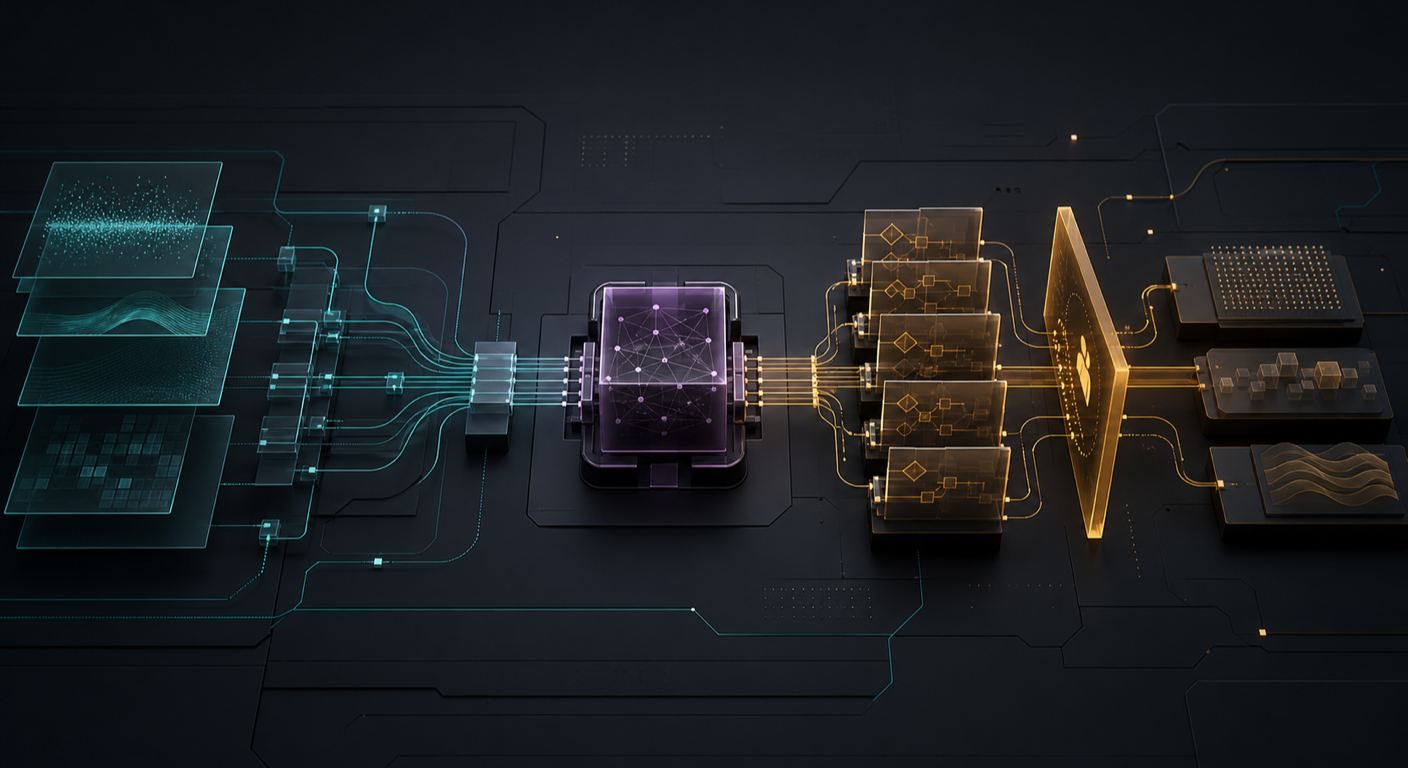
Many companies describe projects as AI initiatives when the work is mainly integration. A support tool gets a language model, a reporting screen gains a forecasting feature, or an internal search box starts answering questions. The label then appears in strategy decks, product roadmaps, hiring plans, and quarterly updates.
The AI label makes very different kinds of work sound like the same thing.
There is work that creates new AI capability: developing model architectures, training models, designing learning methods, and extending what a system can do. Then there is work that takes an existing capability and makes it useful inside a particular company. That means connecting it to the right data, placing it inside a workflow, deciding what it may do, building the interface, handling failures, and ensuring the result reaches the next business step.
Most companies are doing the second kind. They are not building AI. They are building products and workflows that use AI.
That work is not lesser. In many cases, it creates all of the business value. But confusing the component with the work sends attention in the wrong direction. Teams focus on model intelligence when their actual challenge is making that intelligence useful inside their particular business.
The distinction matters because these projects need different people, different architecture, and different measures of success. Integration is valuable enough to be named honestly.
“Add AI” is not a project scope
Imagine a leader saying, “We should add AI to customer support.”
The statement sounds like a direction, but it leaves every useful question unanswered. Which part of support should change? Should the system identify intent, find relevant account information, recommend the next action, draft a response, or resolve a case? Who will use the result? What happens when the system is uncertain? Which action marks the work as complete?
“Add AI” names a capability without naming its job.
A project becomes real when the sentence gets narrower: reduce the time agents spend finding the correct refund policy for subscription cases. Now there is a user, a decision, a source of information, and an outcome that can be observed. A model may help interpret the request or retrieve the right passage, but the project is not defined by the presence of that model. It is defined by what changes in the workflow.
Finance has the same problem. “Use AI for invoices” could mean extracting fields, detecting duplicates, matching purchase orders, explaining an anomaly, or deciding which cases require review. These are different products. They need different data and fail in different ways. Grouping them under one technology label hides the choices that actually determine the work.
Remove the AI label
See the work behind the name.
The whole project
AI-powered customer support
The model is one part. The workflow is the product.
Removing the label does not make the project less ambitious. It makes the ambition specific enough to build.
A capability is not a product
A model can summarize a document. A product has to know which document, whether it is current, who is allowed to see it, what kind of summary is useful, where that summary should appear, and what the reader should be able to do next.
A model can predict demand. A product has to assemble the correct history, distinguish a stockout from a lack of interest, choose the planning horizon, deliver the forecast before purchasing decisions are made, and record whether anyone acted on it.
A model can classify a support request. A product has to connect that classification to the current customer, apply routing rules, respect service commitments, and put the case in a queue someone owns.
Capability is what a technology can do in principle. A product is the agreement between that capability and a real operating environment.
An impressive demonstration can be misleading without being dishonest. It isolates the capability so it is easy to see. A useful product does the opposite: it surrounds the capability with context and constraints until it can participate reliably in ordinary work. The model becomes less visible while the system becomes more complete.
Calling both of these “AI” makes it difficult to see where the remaining uncertainty lives. If the model already performs the narrow task well, another month of model comparison may add very little. The unresolved questions may be about identity, permissions, data freshness, exception ownership, or what the next system expects to receive. Those are integration questions, and they do not disappear when the model gets smarter.
Custom AI does not necessarily mean a custom model
Companies often assume that a differentiated AI product must begin with a model nobody else has. Otherwise, if competitors can call the same API, what is custom about it?
Almost everything that makes it belong to the business.
Two companies can use the same model for customer support and build entirely different products. The first gives employees a standalone chat window and asks them to paste in customer messages. The second connects a knowledge base, so the response is better informed, but still leaves employees to look up the account and copy the result into the support system. The third assembles the verified customer, order, subscription, and policy context automatically; places the recommendation inside the existing case screen; separates actions the system may take from those requiring approval; and records the outcome for later review.
The underlying capability is shared. The products are not.
Architecture exercise
Design the path from request to refund
“My subscription renewed yesterday. Can you refund me?”
Same base model in every configuration
Identifies the request and drafts a response
The employee still has to
Business outcome
Useful draft
If an employee moves the data and actions between systems, the employee is the integration.
The custom work can live in how the problem is decomposed, which context is assembled, where rules are enforced, how people interact with the result, and how outcomes return as feedback. Over time, those decisions accumulate into a system that a competitor cannot reproduce merely by opening an account with the same model provider.
There are problems that genuinely require new model development. TensorBundle works on those too. But when an existing model already provides the needed capability, training another one is not a mark of seriousness. It may be a refusal to notice where the actual product work lives.
The best integration may make the AI invisible
The easiest way to show that a product uses AI is to put a chatbot in it. The user sees a blank box, types a request, and receives generated text. The technology is unmistakable.
The workflow improvement may be harder to find.
If a support agent has to leave the case, open the AI tool, paste the customer’s message, add missing context, inspect the response, and copy the result back, the company has added an interface without integrating the capability. The employee remains the connection between every system.
A deeper integration might appear as the correct policy surfaced beside the case, a draft grounded in the current account, or a recommended action inside the screen where that action can be approved. In demand planning, it may appear as an unusual forecast highlighted before the purchasing deadline. In document processing, it may appear as three uncertain fields routed for review while the rest move forward normally.
None of these experiences needs to announce itself with a sparkle icon. The user should understand what the system is proposing, which evidence supports it, and what control they retain. They do not need to be reminded that a model participated in producing it.
This is a useful reversal for product teams. Instead of asking how to make the AI feature visible, ask how much unnecessary work disappears from the user’s path. The most mature result may look less like an AI destination and more like the existing product finally understands what the user is trying to accomplish.
The model should be the most replaceable part
Early AI products often treat model selection as a permanent identity. They describe themselves as being powered by a particular provider or model family, then let that choice spread through prompts, data structures, application logic, and user interfaces.
But models will change faster than the business around them. Providers release new versions, retire old ones, alter pricing, and improve different capabilities at different rates. A company may also need a smaller model for cost, a local model for privacy, or a specialist model for one part of the workflow.
The customer record, approval policy, case history, and definition of a completed refund should not have to change with them.
A well-integrated product gives the model a bounded role. Context is assembled before the request reaches it. Its output must meet a defined contract. Business rules, permissions, and consequential actions remain in the surrounding system. Evaluation cases describe the behavior the product needs rather than the quirks of one provider. Changing models still requires work, but it does not require rediscovering what the business process is.
30-day shutdown notice
What breaks when the model disappears?
Select what you expect to lose.
Integration is not finished when the first API call succeeds. Data schemas change. Permissions change. Business rules change. Users find new ways to use the tool. The integration is the long-lived product that absorbs those changes while allowing the capability inside it to improve or be replaced.
If the model is the hardest component to remove, the product may not own enough of itself.
Naming the work correctly changes who should build it
Language shapes the project before architecture does.
Call something an AI project and the first questions tend to be about models: which provider, which benchmark, which prompt, which specialist to hire. Those may be legitimate questions. But if the company is integrating an existing capability, the difficult work may sit elsewhere.
Someone has to understand the business process well enough to decide what should change. Someone has to make the relevant data available without ignoring access boundaries. Someone has to build the product path, define the contracts between components, design the exception experience, test the complete outcome, and take responsibility after launch.
That team may need machine-learning expertise, especially to evaluate behavior and understand where model limitations matter. It also needs product, backend, data, security, and domain expertise. More importantly, it needs people who can work across those boundaries. A collection of excellent specialists does not automatically produce an integrated system if nobody owns the path between them.
Naming the work correctly also changes success. A team creating a new model capability may reasonably celebrate a research result or benchmark improvement. A team integrating an existing capability should care whether the resulting system improves the decision or workflow it entered. Did cases reach resolution faster? Did fewer invoices require rework? Did planners act on the forecast? Did employees adopt the tool without becoming its manual plumbing?
At TensorBundle, this distinction changes how we approach a problem. Sometimes the constraint is genuinely inside the model and the work demands new methods. Often the model can already do its part, and the meaningful challenge is building the system around it. Treating those situations as identical would produce the wrong recommendation before the project even begins.
The next time someone proposes an AI initiative, do not begin by arguing about whether it deserves the label. Ask a more useful question: are we creating a new capability, or are we making an existing capability work here?
If the answer is integration, say so without apology. Then design the product, team, and expectations around the work you are actually doing.