
Picking an architecture usually does not feel like a big decision. Maybe there is a model that is clearly dominant, or a colleague who has already used something, or a benchmark that looks close enough. You make the call and move on.
What takes longer to notice is that the architecture you picked already contains a theory of your problem: assumptions about what the data looks like, what the task requires, and what the system can actually get good at. Those assumptions do not announce themselves. They quietly shape what improves with more investment and what hits a wall.
Most teams run into this eventually, as a performance plateau that resists the usual fixes. The architecture question is usually the last one they think to ask.
Every architecture is a theory about how reasoning works
Each architecture commits to a specific theory of how understanding works, and that theory shapes everything downstream. The bet is built into the design itself, not added on top of it.
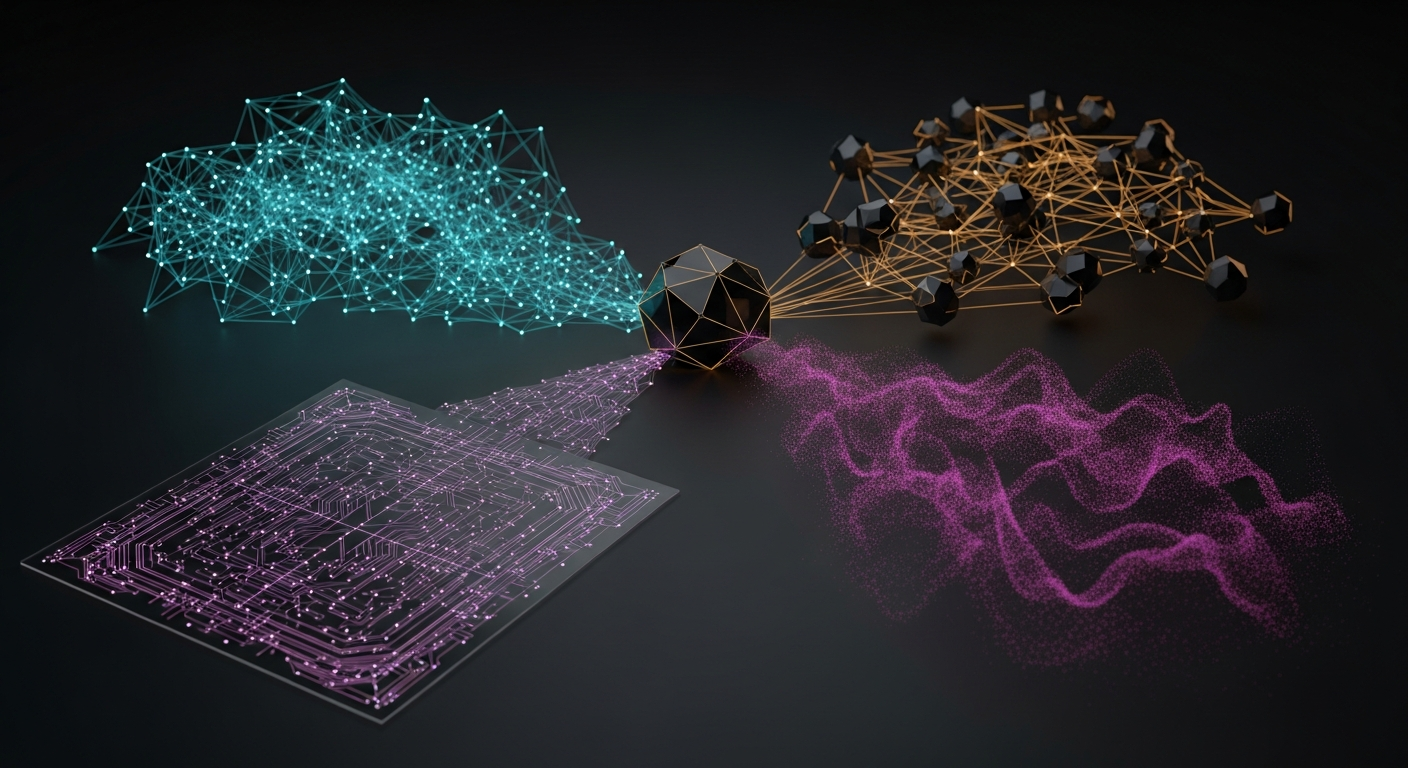
Take transformers. Their core bet is that context is everything. Every part of the input is potentially relevant to every other part, and the model learns which connections matter. When you read the word “bank,” its meaning depends entirely on what surrounds it: is this about rivers or money? Transformers are built to resolve exactly that kind of dependency, across any distance in the input. Global context, made globally available.
CNNs start from a different premise: that proximity is what defines structure. Pixels near each other constrain each other; pixels far apart mostly do not. Complex visual understanding emerges by composing simple local features at increasing scales, edges into shapes into objects. For images, this maps well onto how the data is actually organized. For a fraud detection graph, where “nearby” carries no spatial meaning, it does not.
GNNs are for when the relationships are the data. Not the nodes, the edges. In a fraud network, what matters is not any single transaction in isolation but who sent money to whom, which accounts cluster together, which connections keep appearing under different names. A GNN passes information along those connections and lets meaning accumulate through the graph rather than inside individual records.
Diffusion models work differently from all of them. Instead of predicting output sequentially, they start with noise and iteratively remove it, guided by a signal toward the target. Generation as refinement rather than generation as prediction. It is an odd way to think about it until you see what it produces.
These are not engineering decisions with different price-to-performance tradeoffs. They are different answers to the question of what computation is actually doing when it reasons. Your problem implicitly favors one of those answers. The question is whether your architecture matches it.
The architecture does not just set the method. It sets the assumptions.
Pick a transformer and you have already committed, before writing a single line of training code, to the belief that global context is valuable: to understand any part of the input, you may need to attend to any other part. For language, this is often true. For an image classification task where what matters is whether the object’s edge is straight or curved, it is irrelevant and expensive.
Pick a CNN and you have committed to the assumption that spatial locality matters. Nearby pixels define structure; distant pixels do not constrain each other much. This assumption is so well-matched to how visual data works that CNNs dominated computer vision for years. It is also why applying one to a relational graph produces poor results no matter how carefully you tune it. In a graph, “nearby” has no meaningful definition. The assumption simply does not hold.
The gap between a mismatched architecture and your problem cannot be fully closed. You can prompt around it, fine-tune around it, add scaffolding. But you are working against the grain, and eventually the grain wins. The outputs become technically reasonable but structurally wrong in ways that are hard to articulate and harder to fix.
Some questions do not fit some architectures. The mismatch is structural.
The model underperforms on a specific task type. The data is good and it still does not work. The instinct is to look for a surface-level fix: sharper prompts, more examples. Or to blame the data. Sometimes it is neither. Sometimes the issue is a mismatch between the type of question and the architecture being asked to answer it.
Each architectural family fits a different kind of question. Some are built around classification and retrieval. Others around generation. Others around finding structure in graphs and networks. The architecture does not just answer these questions with different efficiency; it determines which ones fit its structure in the first place.
A transformer applied to a graph relationship problem will not just underperform a GNN. It will fail to exploit the relational structure that makes the problem tractable at all. Throwing more parameters at it or tightening the prompt does not change this, because both of those levers operate within the model’s existing structure.
If a model keeps failing on the same task type, the usual explanations are surface-level: the prompt, the data, the hyperparameters. Whether the architecture fits this type of question at all is a deeper question, and it is rarely asked.
Where each architecture fits and where it does not
A quick reference for where architectural bias helps, and where it works against the problem.
Classify or retrieve
Transformer
Strong
CNN
Partial
GNN
Partial
Diffusion
Mismatch
RNN-LSTM
Partial
Generate text
Transformer
Strong
CNN
Mismatch
GNN
Mismatch
Diffusion
Partial
RNN-LSTM
Partial
Generate visuals
Transformer
Partial
CNN
Partial
GNN
Mismatch
Diffusion
Strong
RNN-LSTM
Mismatch
Find relationships
Transformer
Partial
CNN
Mismatch
GNN
Strong
Diffusion
Mismatch
RNN-LSTM
Partial
Detect spatial patterns
Transformer
Partial
CNN
Strong
GNN
Mismatch
Diffusion
Partial
RNN-LSTM
Mismatch
Process sequences
Transformer
Strong
CNN
Partial
GNN
Partial
Diffusion
Mismatch
RNN-LSTM
Strong
The architecture sets the ceiling. Everything else fills the space below it.
Two models trained on identical data with different architectures will reach different capability ceilings on the same task. The data determines how fully each model reaches its ceiling. Where that ceiling sits is an architectural question, not a data question, and it does not shift no matter how much you invest below it.
So if a model trained on good data continues to underperform on a specific task type, you are probably not facing a data problem. You may be facing a structural limit on what this class of model can do on this class of task.
The expensive version of this mistake is not discovering it early. It is discovering it after a long stretch of iteration, when a team has built significant infrastructure around an architecture that cannot do what the product actually needs. By that point, switching is costly, the original rationale has faded, and the problem gets attributed to data quality, training processes, or the model provider, rather than to the decision made in the first sprint.
How to make the choice consciously: a three-layer framework
The right architecture usually becomes clear when you look at the problem from three layers at once. Most teams pick from one layer, usually name recognition or benchmark scores from someone else’s problem. All three together narrow the field fast, and none of it requires more than an honest conversation about what the problem actually is.
The first layer is the computational shape of your problem. Is the problem pairwise? Does every element potentially relate to every other, the way words in a sentence constrain each other across any distance? That points toward transformers. Is it spatial, where structure emerges from proximity the way pixels in an image are defined by position? That points toward CNNs. Is it relational, where meaning flows through connections between entities rather than residing in the entities themselves? That points toward GNNs: fraud networks, recommendation systems, molecular models. Or is it generative by refinement, where you need high-quality structured output through iterative improvement rather than sequential prediction? That is the diffusion space. The computational shape of the problem narrows the field considerably before you look at a single benchmark.
The second layer is the type of question you are asking. This is distinct from data shape; it is about the structure of the inference. “What is this?” maps to encoder-style architectures. “Generate something from this” maps to decoder-style transformers. “What does this look like?” maps to diffusion. “What is the relationship between these?” maps to GNNs. Two teams in the same industry often need completely different architectures because they are asking structurally different types of questions of their data, and the question type alone eliminates most of the option space before you evaluate any specific model.
The third layer is what your domain’s data actually looks like. Healthcare data is not monolithic: long clinical notes point toward transformer models with extended context, structured records often fit classical approaches or hybrid architectures, and medical images point toward CNNs. Three different data shapes, three different architectural families, all inside the same organization and often describing the same patient. Financial data has time-series transaction streams, tabular risk features, and relational fraud networks. Legal work is dominated by very long documents with complex cross-references, which strains transformer architectures not designed for extended context. Manufacturing involves sensor streams and high-precision visual inspection at scale. The sector tells you less than the data shape does.
When all three layers agree, the choice is usually clear. When they point in different directions, that tension is worth paying attention to: it typically means the problem contains multiple sub-problems with different architectural needs, and the right system design reflects that rather than forcing everything through a single model.
Which architecture fits your problem?
A quick check before a model choice turns into infrastructure.
1 of 3
Step 1: Information shape
Selected
What kind of information are you working with?
Pick the answer that describes where the useful signal mostly lives.
The decision you have already made
Most teams do not choose their architecture so much as arrive at it, pulled toward whatever is most visible in the AI discourse at the time. Right now that means transformer-based language models, which are powerful and well-matched to a large class of problems. They are also not well-matched to spatial visual classification, relational fraud detection, structured image generation, or time-series forecasting where sequential order is strict. Using them for those problems is not incompetence. It is the predictable result of never asking the question.
Every system has an architecture. The only question is whether it was chosen or defaulted into.
The architecture decision deserves deliberate thought before the first implementation choice. Three layers, applied honestly to the actual problem. Teams that do this tend to build systems that work better and are less painful to maintain, not because they found a better model, but because they understood what they were choosing.
That understanding is available to anyone willing to ask before they build.